






Folding knife - Brass finish - SS
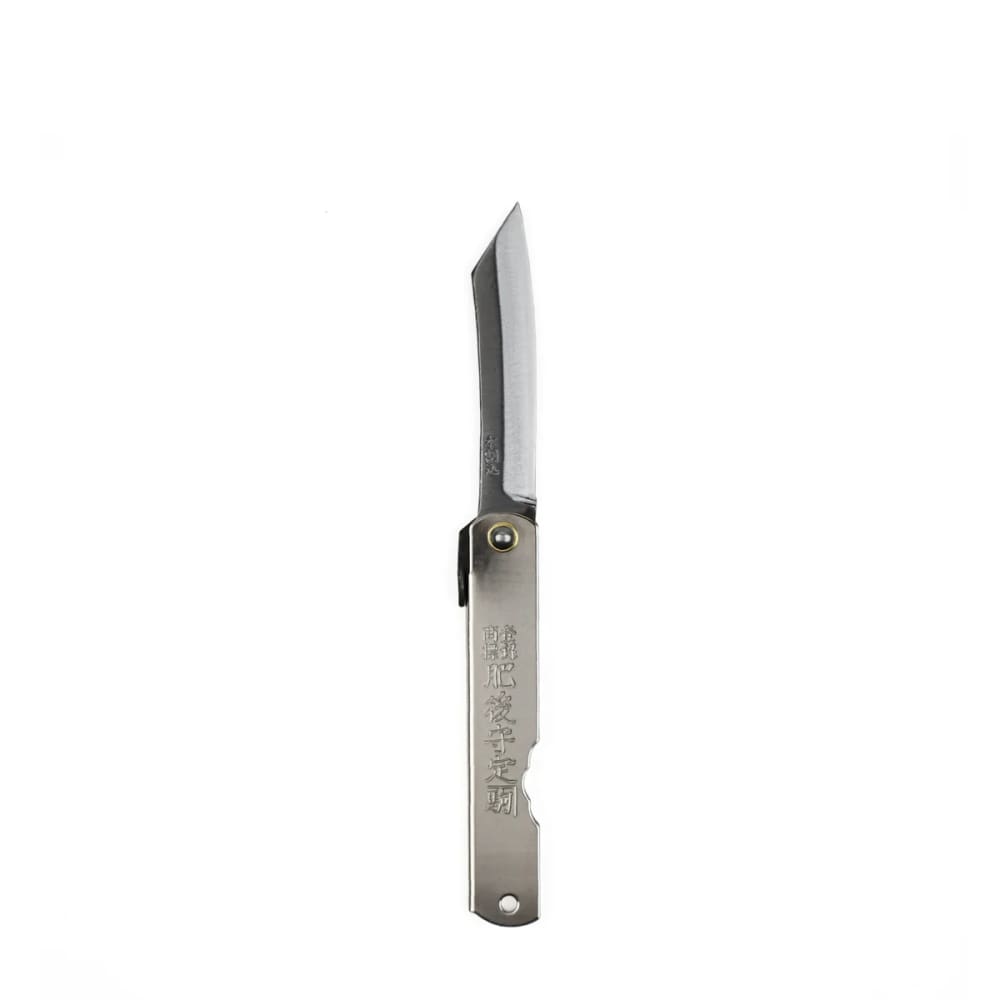
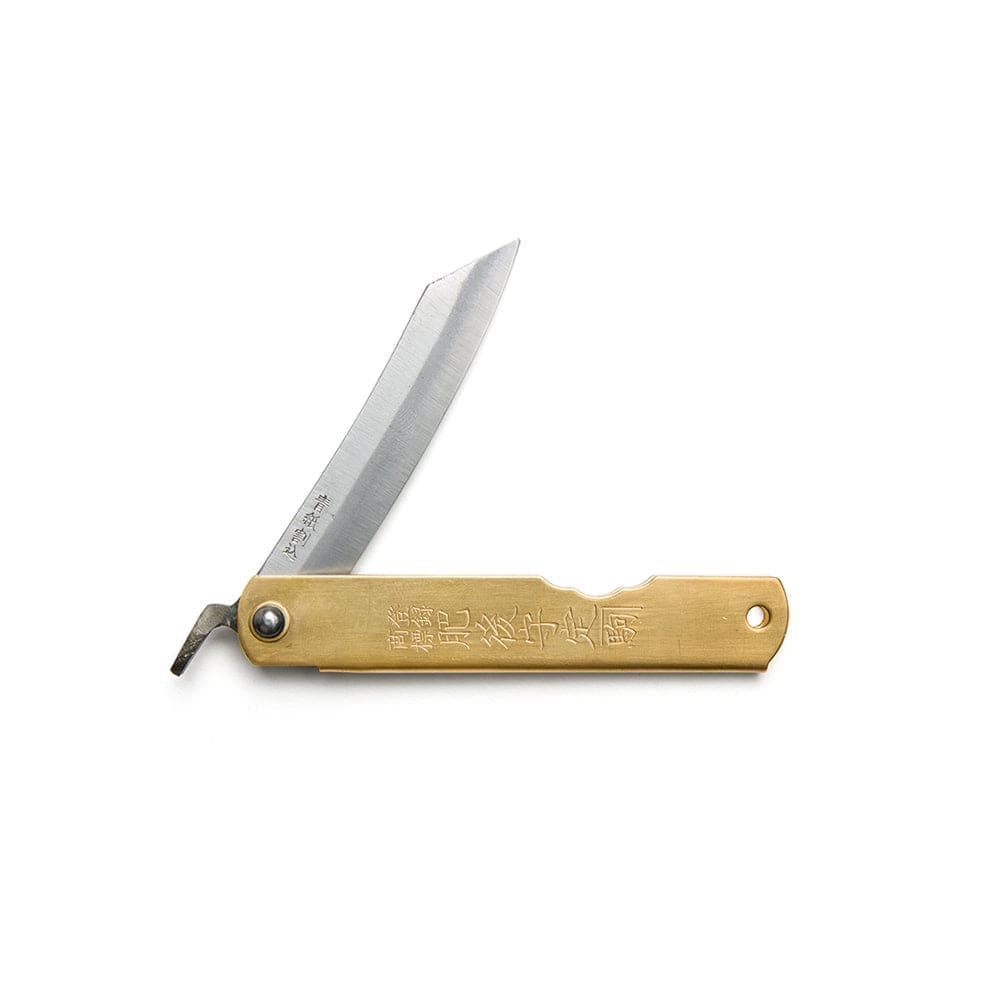
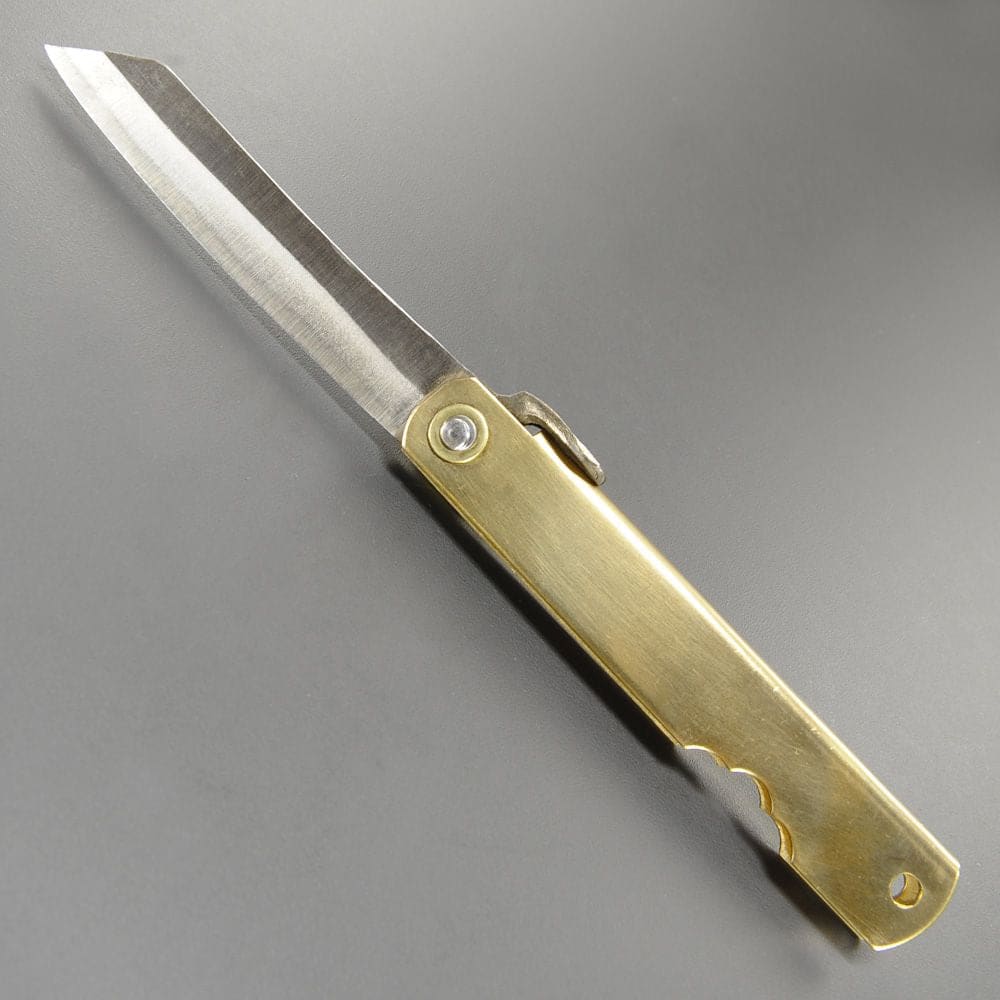
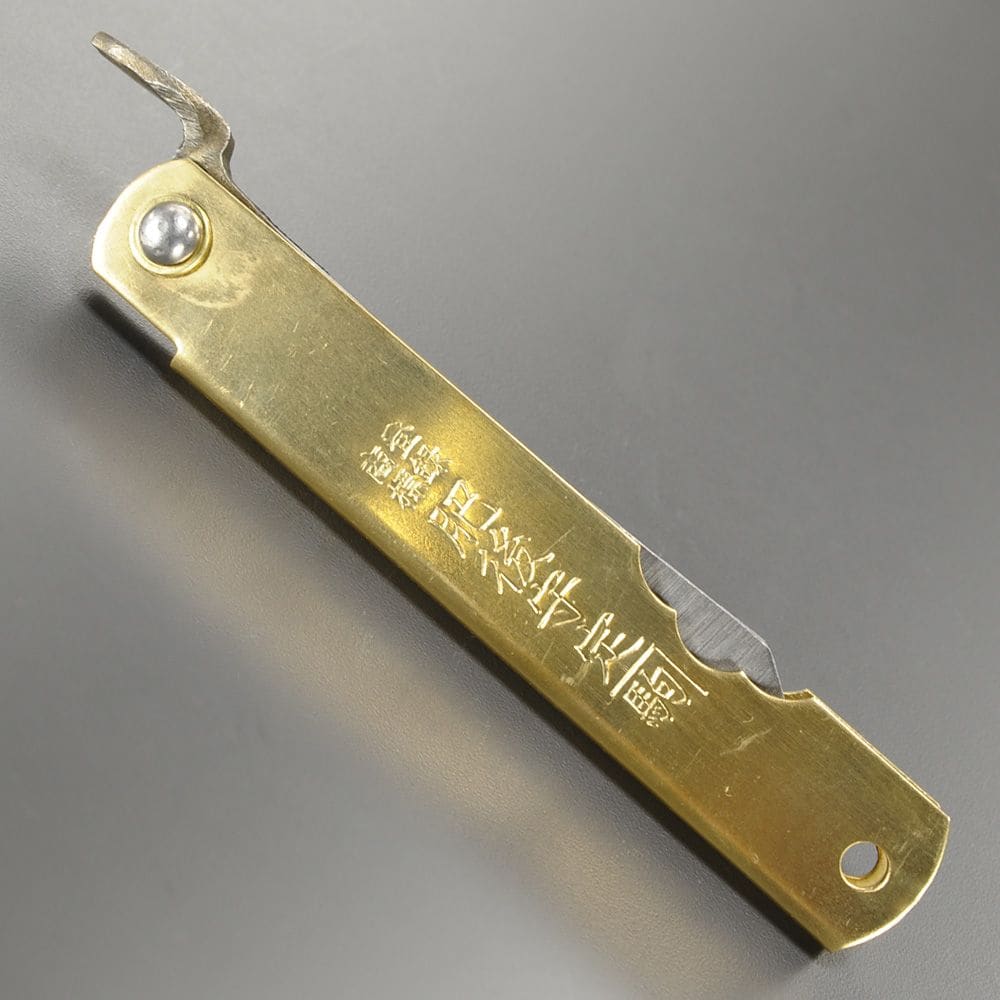
The Higonokami SS is the most compact model in the HIGONOKAMI range: approximately 90 mm open, with a 55 mm sheath and a blade approximately 38 mm long made of double-edged SK carbon steel sandwiched between mild iron. Brass handle, lanyard hole, made in Japan.


BRASS-FINISH FOLDING KNIFE - SS
Japanese-style HIGONOKAMI blade in SK carbon steel. Brass handle.
This is a very small knife, but it remains very sharp.
The blade has a structure in which an SK carbon steel core is sandwiched between layers of mild steel, making it more resistant to cracking. Thanks to its V-shaped double-edged blade, it can be used equally well with either the left or right hand, regardless of your dominant hand.
There is a hole at the back of the handle, so you can thread a cord through it.
Carbon steel blade: wipe it after use and lightly oil it to prevent rust.
- Cord hole
- Total length: approximately 90 mm (sheath 55 mm)
- Blade length: approximately 38 mm
- Blade thickness: 2.5 mm
- Specifications: SK steel, double-edged
- Sheath: Brass
Also explore: Higonokami, Pocket Knives and Accessories.
Features
- Dimensions
- Approximately 90 mm (55 mm sheath)
- Weight
- 65 g
- Material
- Carbon steel, Brass
- Color
- Gilded
- Origin
- Japan
About HIGONOKAMI
Knife manufacturing began in the late 19th century in Hirata, in the village of Kurumi, Minō District (now Miki). Mr. Murakami and Komataro Nagao, the founder of the lineage, were the first craftsmen. At that time, the knives were made entirely by hand: the blades, made of steel inserted into iron, were meticulously forged, while the sheaths, made of brass or blackened iron, were decorated with engravings depicting people, horses, flowers, or landscapes.
Around 1894, Tasaburo Shigematsu, a hardware wholesaler, drew inspiration from a knife brought back from Kagoshima to design a folding model that was practical and portable. This new type of knife, named “Higonokami,” marked the beginning of production of the famous folding knives. Since then, their shape has evolved into the form known today.
Registered in 1910, the Higonokami trademark is protected. Although several manufacturers were involved in its production in the past, Nagao Kanekoma Seisakusho is now the only one authorized to use this iconic name, having been passed down through 5 generations of master cutlers.
A blade that folds into the handle
A Higonokami is recognizable by its folded metal handle, made of chrome-plated iron or brass, into which the blade folds. The blade is made of Japanese-style carbon steel and sharpened in a V on both sides, making it suitable for both left- and right-handed use. Depending on the model, a core of Aogami blue steel or SK steel is sandwiched between soft iron, a construction that makes it more resistant to cracking. Like all carbon steel, the blade should be wiped after use and lightly oiled to prevent rust. The knife remains lightweight and can be carried on a cord thanks to the hole drilled at the back of the handle. Four sizes are available, from the approximately 90 mm SS to the approximately 215 mm LL when open.
Construction
What makes a Higonokami
The sandwich blade
On the S and LL, an Aogami blue steel core is sandwiched between two layers of mild iron; on the SS, an SK steel core. The blade gains resistance to cracking.
The V-shaped edge
The blade is sharpened on both sides, in a V shape. It cuts equally well for both left-handed and right-handed users.
The metal handle
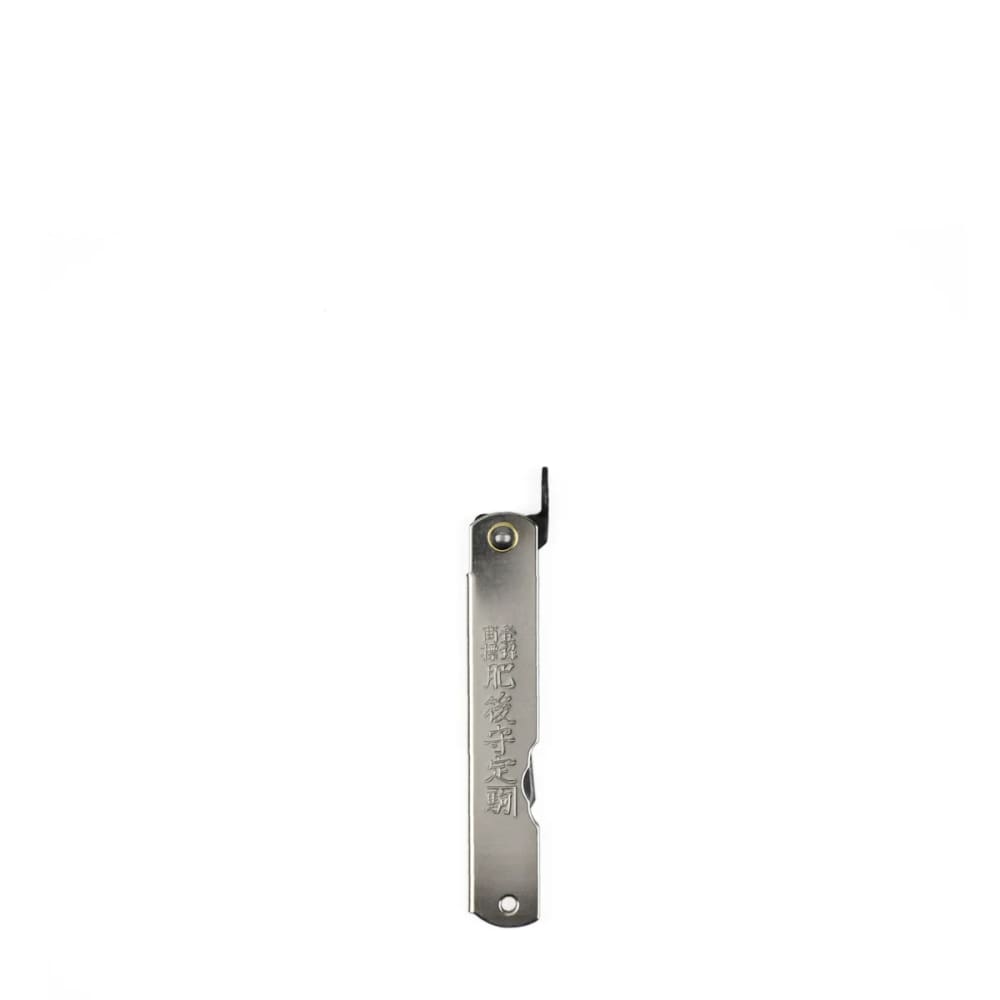
The handle is made of textured chrome-plated iron on the L model, and of brass on the SS, S and LL models.
The chikiri
The small tang of the blade, the chikiri, protrudes from the handle. Pressing your thumb is enough to open the knife.
The hole for the cord
At the back of the handle, a hole allows a string to pass through. This way, the knife can be kept on the wrist, on a bag, or on a keychain.
Four formats
From S, approximately 90 mm overall and 38 mm blade length, to L, 215 mm open and 95 mm blade length. S and L fall between the two.