






The keychains of the Japanese brand Picus, “the antiques of the future”
Made with materials that change over time, the products of the Japanese brand Picus are designed for daily use and to evolve with their owners. The brand’s creations feature an aesthetic that is both old and modern, which is why they are affectionately nicknamed “antiques of the future” by their creator Masayuki Honami.
Among the many products sold by the brand, the keychain range is particularly interesting. Their original design, reminiscent of old hotel room keys or luggage tags, makes them perfect accessories to personalize everyday items. The “luggage tag” keychains, for example, look especially great on a Traveler's notebook travel journal.
The creation of the Picus brand
Founded in 2009 in Tokyo by Masayuki Honami, the brand enjoys creating modern products inspired by the design of old objects that have fallen out of use, giving them a whole new function. It was during his honeymoon trip to England that Masayuki Honami had the idea to bring these old objects back into fashion.
While wandering through the flea markets in the city of London, he realized that people still have a keen interest in these old objects and that they have absolutely not lost their charm despite the passage of time. He even brought back from this trip an old typewriter he found, from which he would make items such as Bookmarks, using the machine's keys.
Before creating his own brand, Masayuki Honami worked at a company that sold various everyday objects. It was through this job that he learned more about the craft and built a list of contacts to access factories to create the very first Picus items.

The brand's items
Since the first Picus creations in 2009, the brand has expanded its catalog and offers for sale a variety of items such as pen cases, clipboards, brass boxes, card holders, brass trays, pen holders, herbariums, and incense holders.
All these objects share the common feature of being designed for daily use and have a simple aesthetic that brings back the style of old objects. These "antiques of the future" are made from materials that change over time, such as brass, copper, leather, and wood. Brass, for example, is a material that develops a patina over time, meaning a brown layer forms on its surface due to oxidation. Simply touching a brass product triggers this natural process that gives it so much character.
Since these materials are very different, they are not produced in a single factory but by artisans specialized in these fields. For example, the coloring of the brand's retractable pens is done manually in a workshop in Takaoka (Toyama Prefecture), a city with a strong industrial past, specialized in copper and lacquer; each pen thus has its own unique pattern. For this reason, Picus items are not produced in very large quantities. Especially since even with the help of machines, the objects must be assembled by hand.
To be able to evolve with their owners, Picus products are very durable and designed for daily use. The brand's creator hopes that seeing the marks left by everyday use on these objects will bring back precious memories for each owner. They are also timeless objects: no matter how much time passes, their charm will not fade. It's no coincidence that they are inspired by various old objects, which still attract many people at flea markets.

Picus brand keychains
Among the brand's flagship products is a beautiful range of keychains. As their name suggests, these items can be used as simple yet elegant keychains. However, it is just as possible to repurpose these objects from their main function, letting your creative side speak a little...
Wooden "hotel room" keychains
Made of wood and brass, their design recalls the keychains to which the keys of ryokan, traditional Japanese inns, were attached. You can also see numbers on these keychains, stamped with gold leaf, reminiscent of the room numbers in these establishments.
Although available in different colors, these keychains are not painted but simply varnished. The different colors come from the type of wood used. For example, keychains numbered 105 are made from cherry wood, those numbered 307 from walnut wood, and those numbered 1027 from merbau wood. The choice is thus left to the buyer to select which number and material inspire them the most.
While this keychain looks great on a keyring, recalling its original use, it also makes a beautiful decorative object. For example, simply hanging it on a hook subtly decorates a white wall.
-The brass and leather “hotel room” keychains
Made of brass and cowhide leather, a material that also ages over time, these keychains have a cylindrical shape that makes them easy to hold in hand. They are also numbered (635, 701, and 829) and have different colors depending on their numbers.
Due to their small size and cylindrical shape, these keychains are perfect for attaching to a zipper slider: the part used to open or close the zipper. For example, they can be attached to the sliders of Okamoto Shoten brand pouches to accessorize them. These keychains then become as elegant as they are practical.

-The brass “luggage tag” keychains
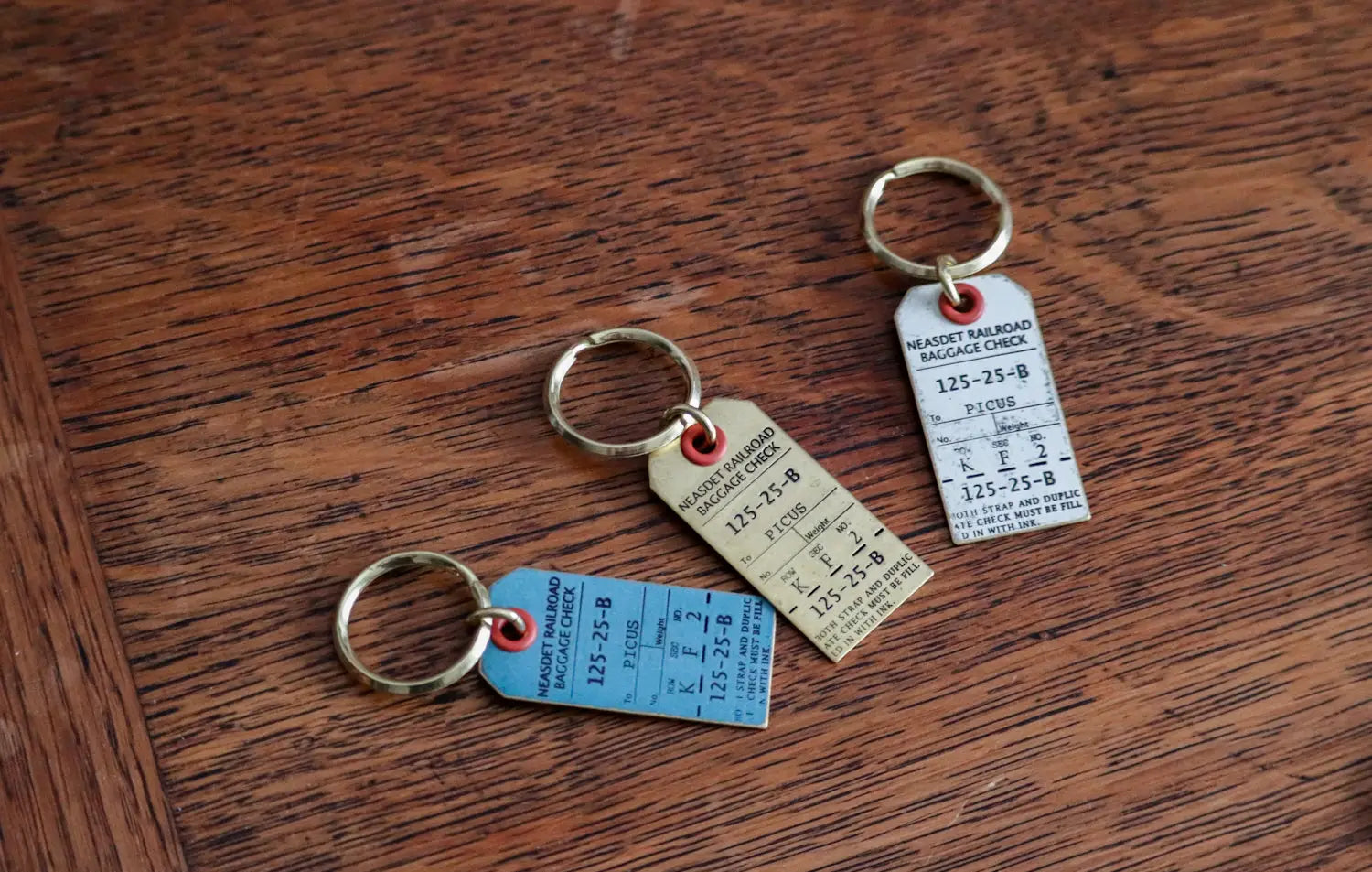
Made of brass, these keychains take us directly back to the era of the first train journeys, where these tags were found attached to the large leather suitcases of travelers… Each keychain is made from the design of an old luggage tag, reproduced on a molded plate. Although the design is based on an old tag, these keychains are both modern and very elegant.
They are available in different colors: ash green, beige, rusty, natural (black or natural writing) and feature a brown brass eyelet. Just like the objects they are inspired by, these luggage tags can be attached to a travel bag or suitcase, but they are also perfect for accessorizing a Traveler's notebook…

Accessorizing your Traveler's notebook
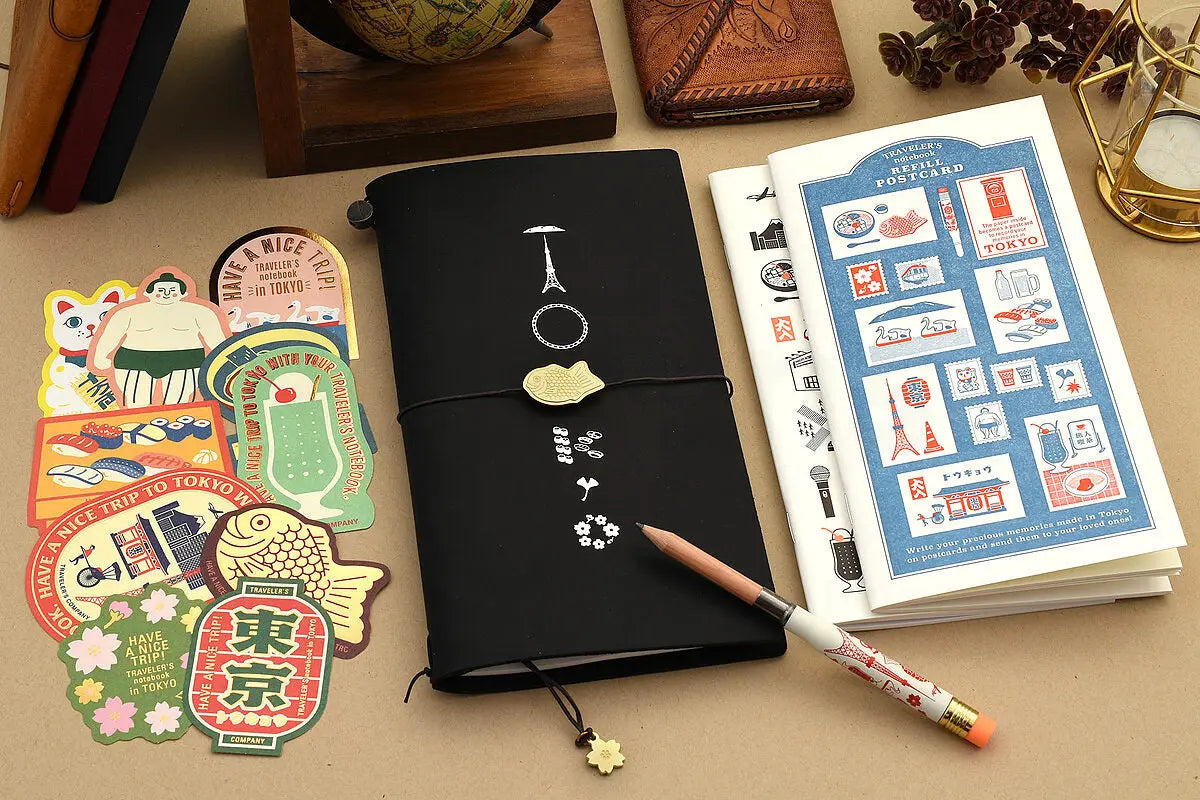
Traveler's notebooks are customizable travel journals, with covers made from vegetable-tanned cowhide leather that recall the notebooks used by great explorers and travelers who, centuries ago, set out to discover new horizons and cultures. This travel notebook closes with an elastic band that can be personalized by adding a small accessory. There are many objects that can serve this role: it can be something with sentimental value, something related to one of your passions, or simply something you like.
For example, and to stay on the travel theme, the Picus “luggage tag” keychains are perfect for accessorizing a Traveler's notebook. The two products complement each other perfectly because, although sold by two different brands, they are meant to be used daily to keep traces of the passing time. While the cover of the Traveler's notebook will gradually get scratched, the paint on the keychains will peel off in places. To personalize your Traveler's notebook with these keychains, it's very simple. Just thread the keychain, with or without the ring, through the elastic band that closes your Traveler's notebook. These keychains are the perfect size and blend very well with the aesthetic of these travel notebooks. Especially since you can choose the color of the elastic band to create a notebook that reflects you 100%.

As you might have guessed, the range of keychains from the Picus brand is ideal for accessorizing and personalizing various everyday items. Their original design, inspired by vintage objects, makes these keychains particularly elegant and charming. They are perfect items that will accompany you for many years. Masayuki Honami, the creator of the Picus brand, is eager to see how all these objects will look in decades to come.

Leave a comment
This site is protected by hCaptcha and the hCaptcha Privacy Policy and Terms of Service apply.